
Michael Wayne Plant: Social documentary within contemporary capitalism
“Photography still has the potential to contribute to change, but not in a direct or immediate way. What it can do is raise awareness and shape how people see and understand a situation.”
Michael Wayne Plant is a London-based photographer whose work moves beyond the conventions of street photography into a more considered exploration of the social landscape.
His long-form documentary practice is concerned not only with what is visible, but with the structures that underpin everyday life — systems of power, capital, and behaviour that often remain unseen. Through careful observation and sequencing, his work builds a visual language that reflects the complexity of contemporary society.
In engaging with his work and thinking, I found it both compelling and challenging — prompting a more critical and reflective way of looking at my own photographic practice, and the assumptions we bring to the images we make.
In this conversation, we delve into his thinking, process, and the role of photography as a way of understanding the world.
© Michael Wayne Plant
JLH: Before we talk about your current projects, could you tell us a little about your journey into photography and what first drew you to the medium?
MWP: Photography was an interest I developed early on, using any camera I could get my hands on. When I was at school, joining the photography club gave me access to the darkroom, which became a place of refuge. I was being bullied at the time, and the darkroom gave me a space where I could step away from that. It was there that I learnt how to print, and from that point everything else began to develop.
While I was still at school in New Zealand, my parents knew a local wedding photographer and introduced me to him. He spoke very openly about how difficult it was to make a living as a photographer, and it painted a fairly bleak picture of the profession. At the time, that stayed with me and discouraged me from pursuing photography more seriously.
There was then a period where photography fell away for a few years. It took me close to ten years to come back to it with any real determination, despite not knowing any other photographers or having a clear path into the industry.
When I did return to it in my early twenties, I decided to apply to study at the Queensland College of Art. At the time, they required applicants to already be working in the industry. In Queensland there was very little of a photography industry, and I had no real contacts, so I needed to find a way in.
I had been buying cameras from a local store for some time, and they knew I was already working in retail and comfortable dealing with customers. When I left my previous job, they offered me a position in the camera store, which gave me the ability to say that I was working in the photo industry, which I needed to apply for the course.
© Michael Wayne Plant
JLH: In your City of London project, if someone looked at your photographs 100 years from now, what do you hope they would understand about this moment in history?
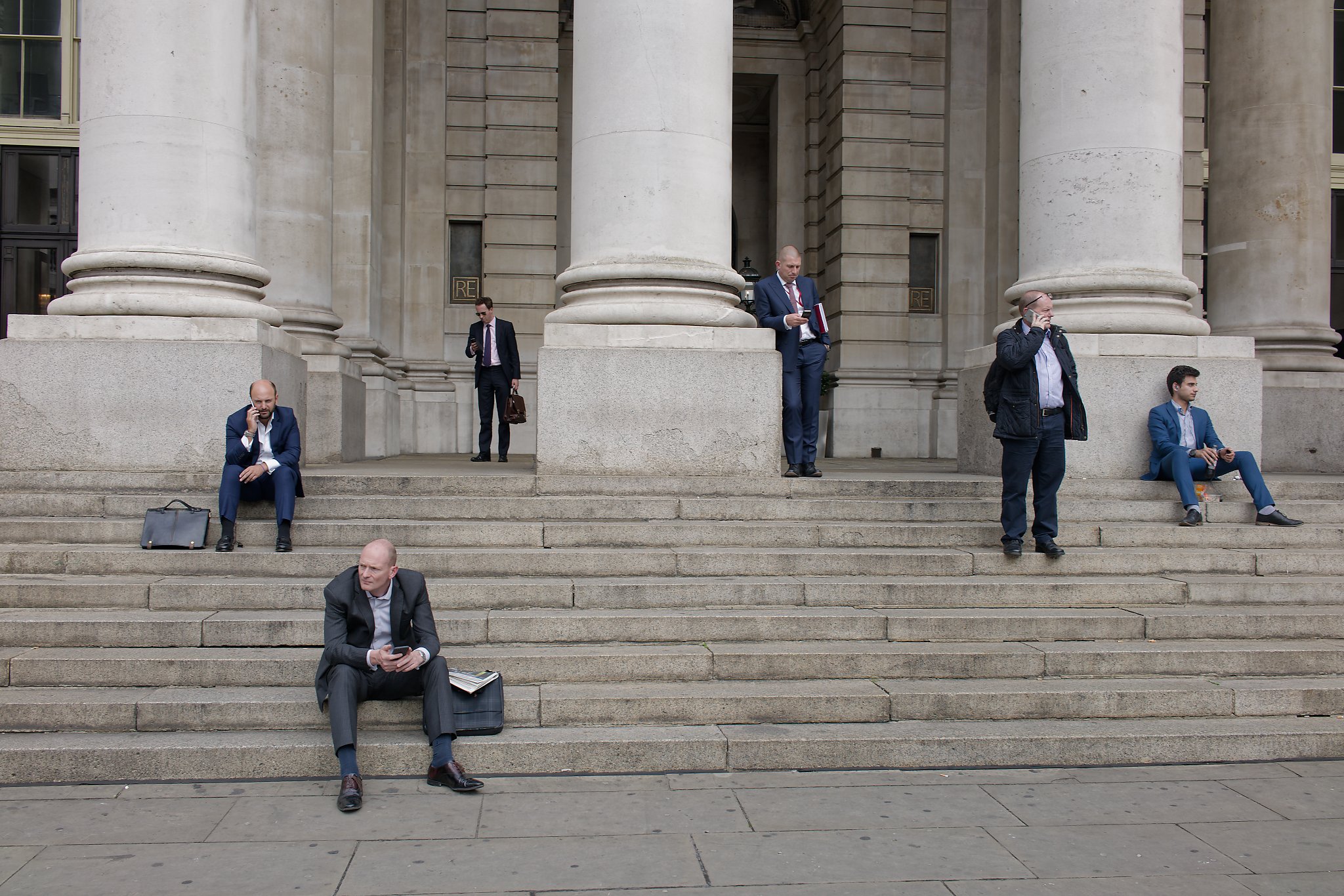
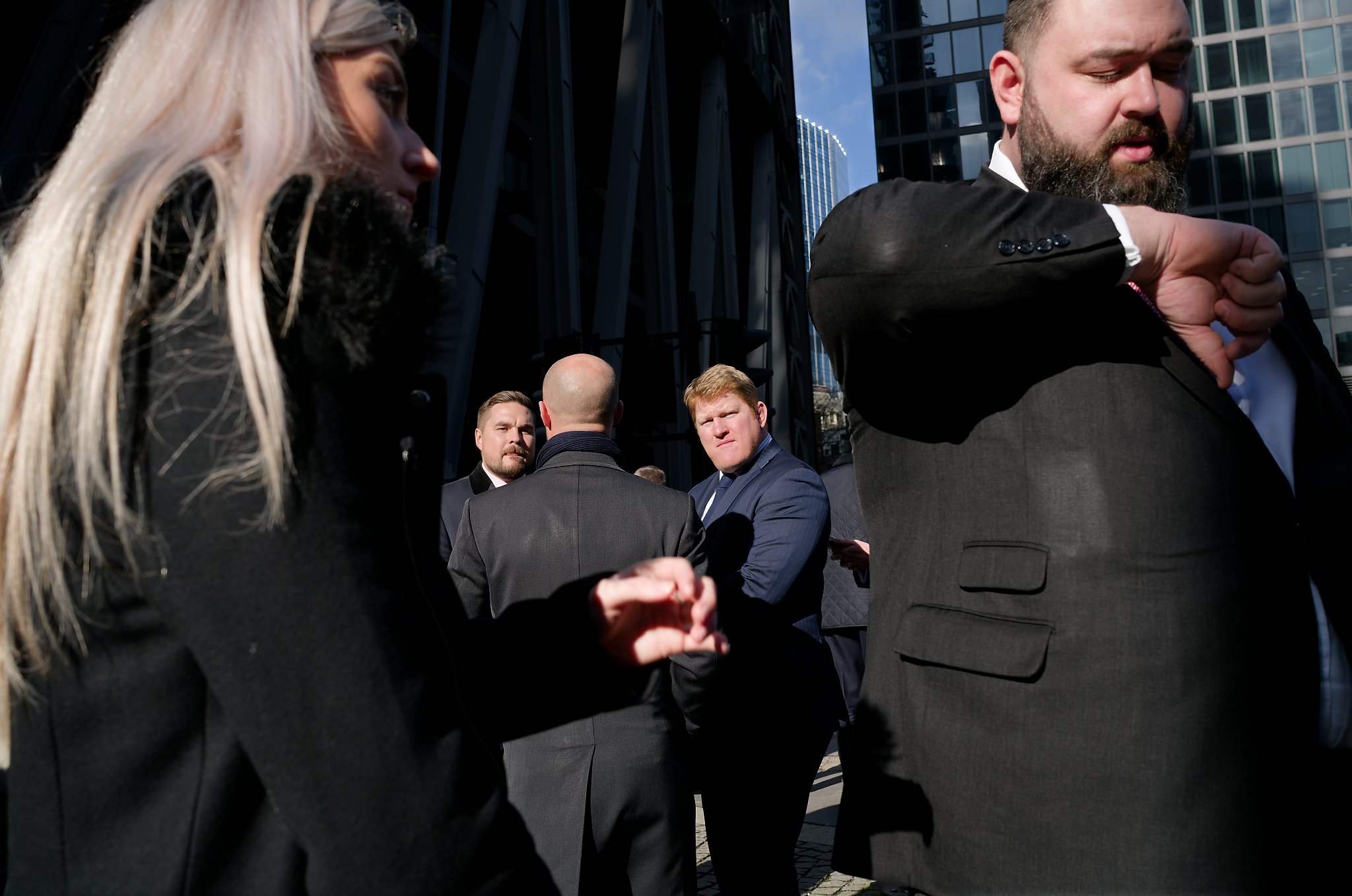
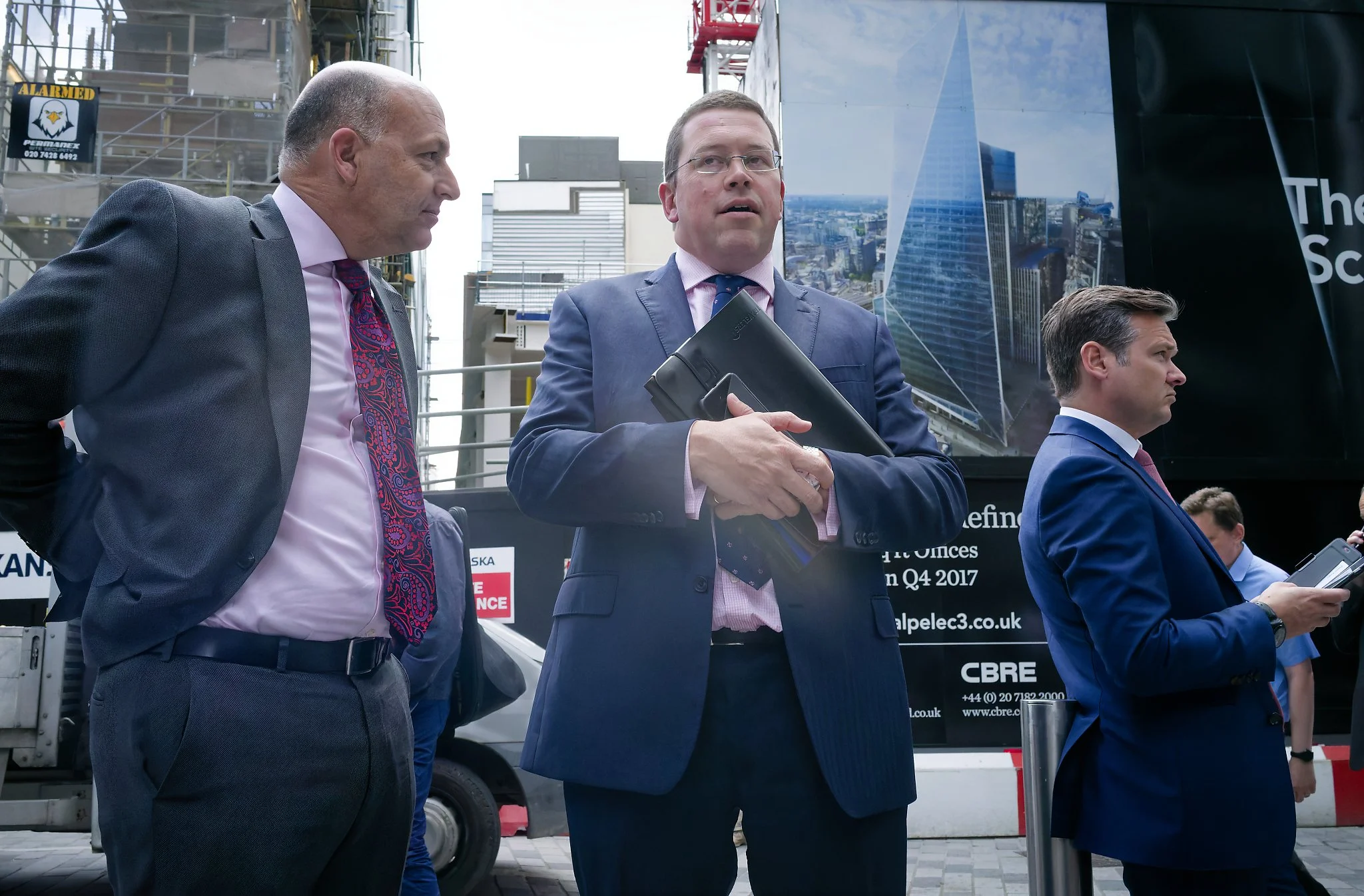
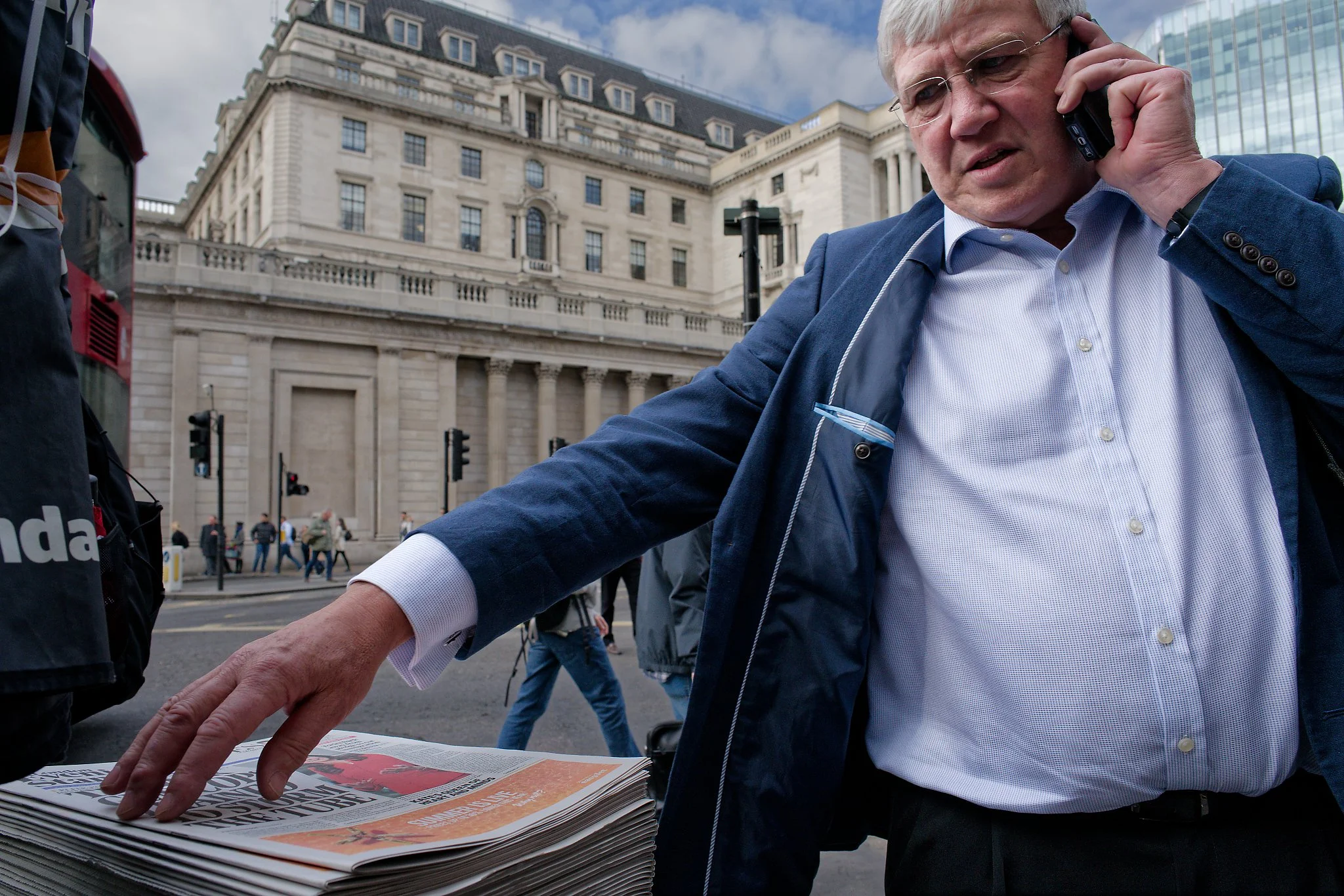
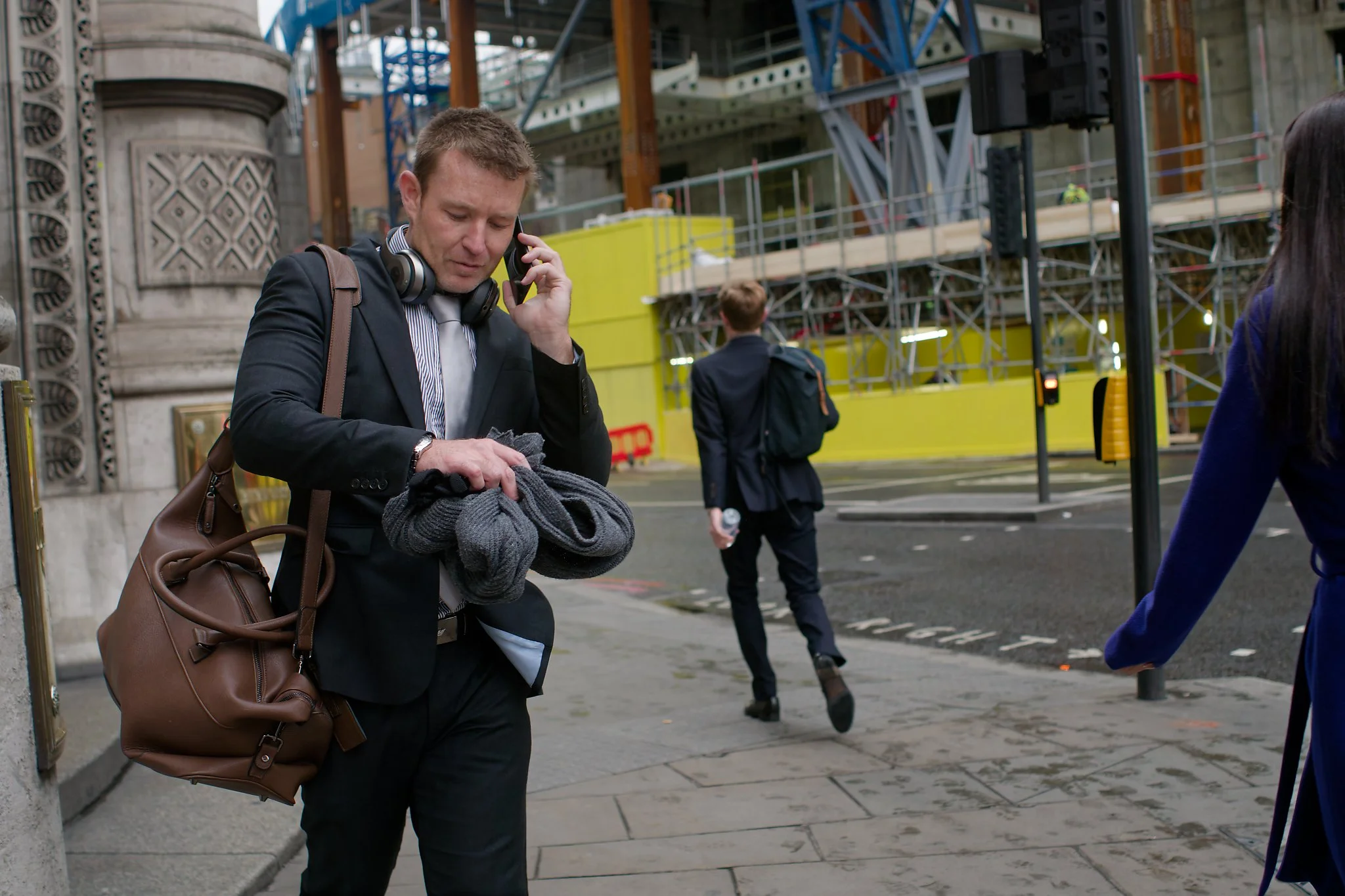
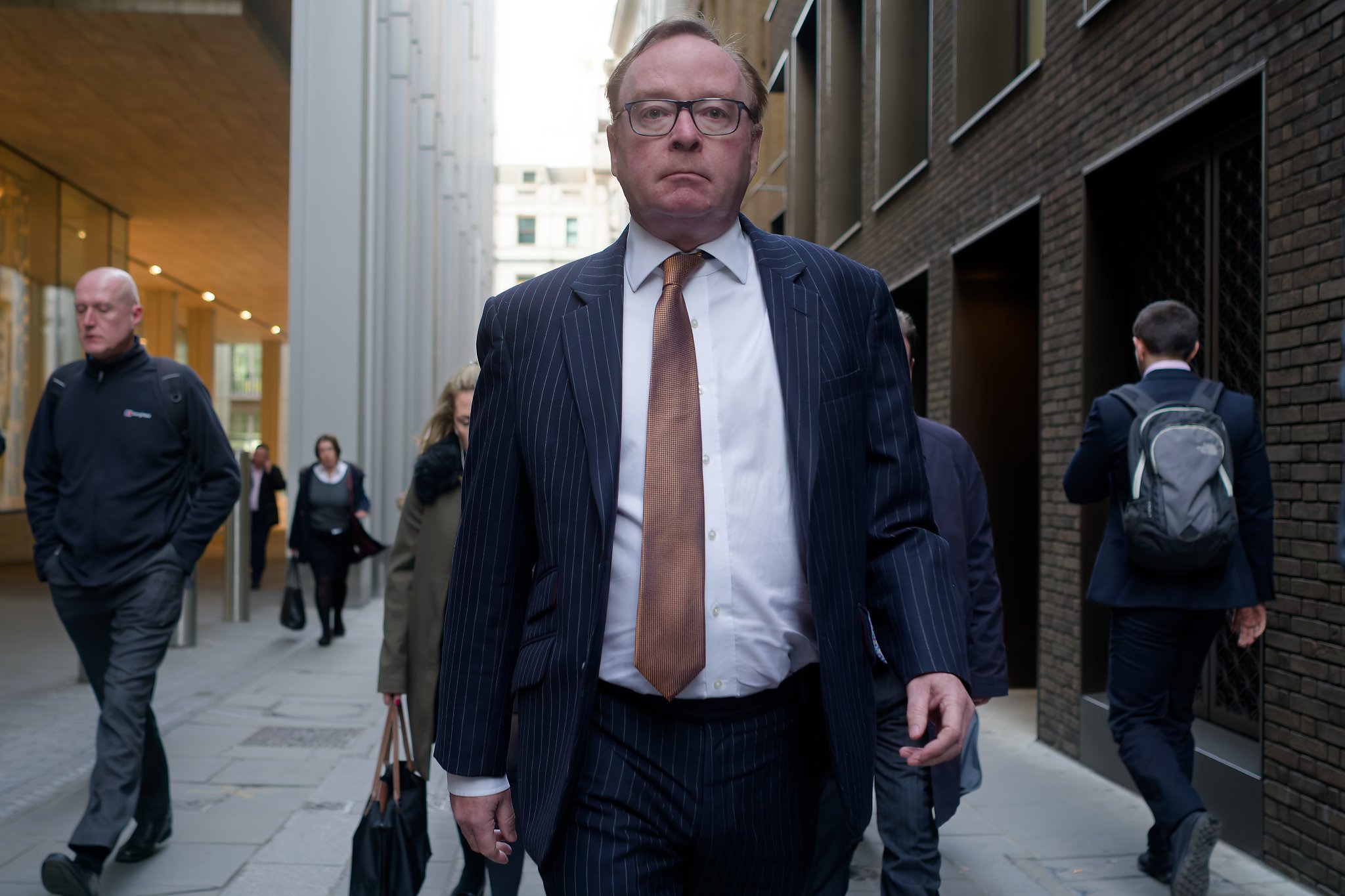
MWP: I would want them to see the traces of the finance industry on the fabric of the City of London, not just in the buildings, but in the way people move, behave and interact within that space.
I am interested in the idea that we live within a social landscape that is not always visible to us. The structures that shape our working lives, particularly those connected to finance and capitalism, are often abstract or difficult to grasp, yet they influence everyday behaviour in very direct ways.
Photography gives me a way to begin visualising that. Not by explaining it directly, but by observing how it manifests in small, ordinary moments. If the work is successful, someone looking at it in the future might begin to understand how deeply those systems were embedded in daily life, even when they were not immediately apparent.
© Michael Wayne Plant
© Michael Wayne Plant
JLH: Street photography often celebrates spontaneity and ambiguity, while social documentary traditionally aims to communicate clear ideas. How do you reconcile those two impulses in your work?
MWP: I do not see those two positions as being in opposition to each other. Street photography brings a sensitivity to timing, ambiguity and the unexpected, while social documentary is more concerned with lived experience and how the social world becomes visible.
In my work, the individual image can remain open and ambiguous, but the clarity develops through the way images are brought together. Meaning is not fixed in a single photograph, it emerges through sequencing, through repetition and variation across a body of work.
So the spontaneity of street photography is still there in the moment of making the image, but the documentary aspect comes later, through editing and the construction of the work as a whole.
JLH: You’ve spoken about the idea of the “social landscape.” Do you see people in your photographs as individuals, or as symbols within a larger social structure?
MWP: Each person is an individual, with their own presence and specificity, and that is important to retain. At the same time, they exist within a wider social landscape that shapes how they move, behave and interact.
What interests me is how a photograph can hold both of those things at once. You see a person in a particular moment, but you can also begin to recognise patterns that extend beyond that individual, pointing towards the larger structures that shape everyday life.
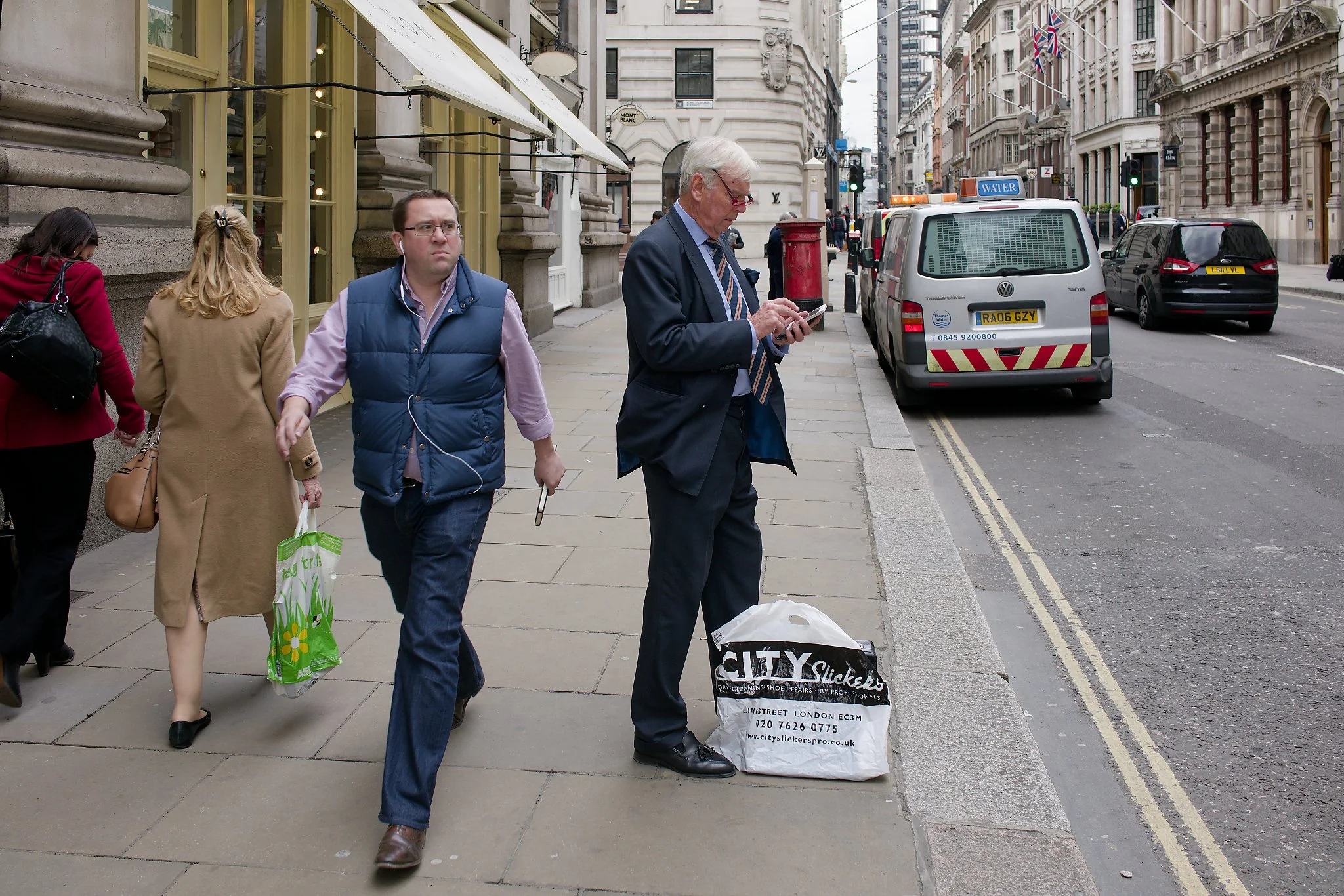
JLH: Many photographers aim to make iconic images. Your work seems more concerned with long-form narrative. Do you think the single photograph is an inadequate form for understanding society?
MWP: Iconic images are a trap. If you set out to make one, you are already working in the wrong direction.
For me, it is more important to understand what I am looking at and to make photographs that reflect that understanding. The difficulty is that our understanding of the world is always partial, particularly when dealing with complex social structures. Because of that, no single image can contain everything that needs to be said.
Meaning develops over time, across multiple images. When photographs are seen in sequence, they begin to accumulate meaning. One image builds on another, creating connections, tensions and visual clues that allow a more complete understanding of what is being described.
© Michael Wayne Plant
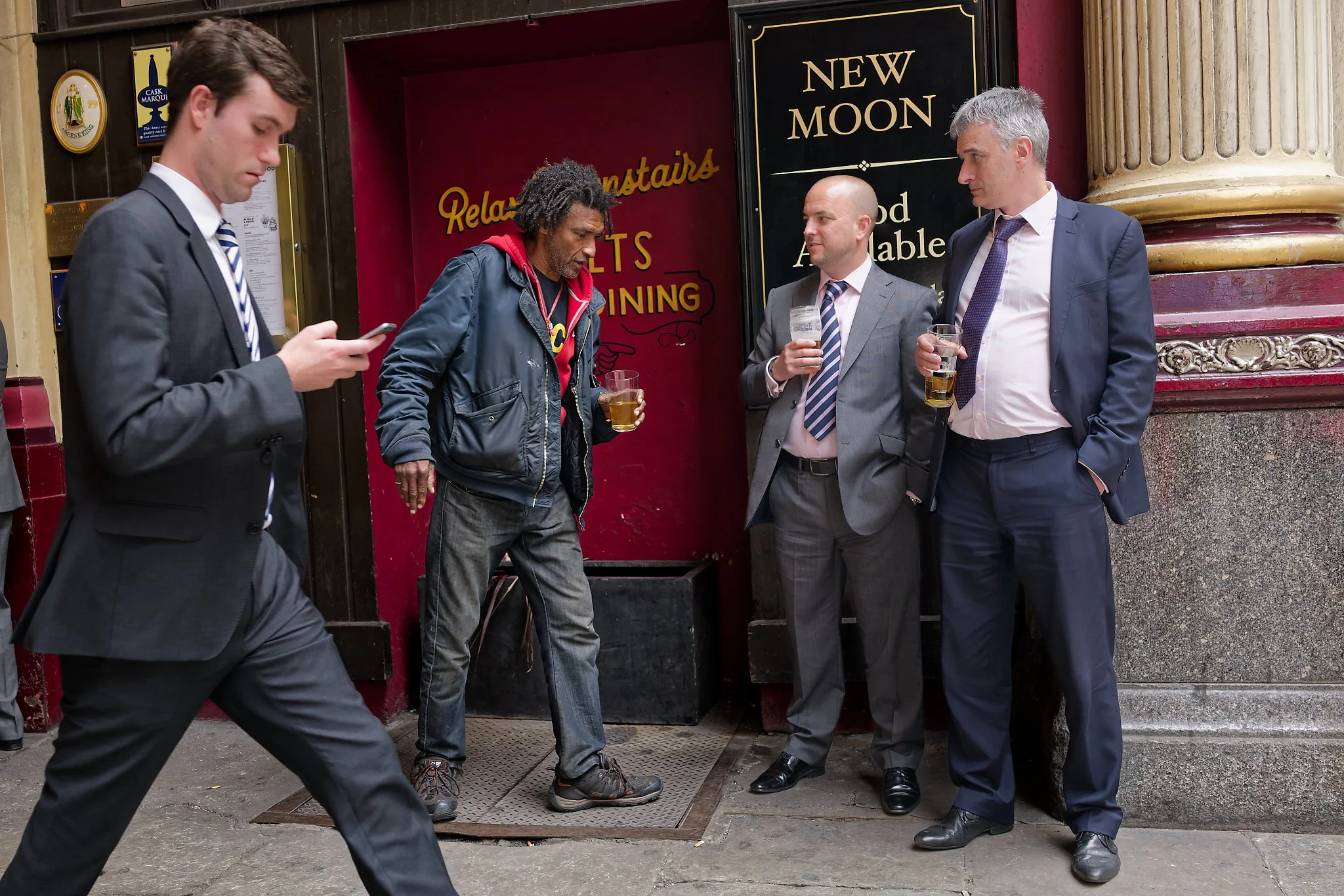
JLH: When working in the same place repeatedly, like the Square Mile, how do you avoid simply repeating visual clichés of the environment?
MWP: This is difficult, because we all develop habits in how we see and photograph, and it is easy to repeat those without realising it.
What I try to do is stay attentive to what is actually in front of me, rather than trying to make the world fit a preconceived idea of what I think it should look like. That requires a certain level of openness, to allow things to present themselves rather than forcing them into a pattern.
Garry Winogrand once said, “I photograph to see what the world looks like photographed.” That idea has always stayed with me. It shifts the focus away from trying to describe the world directly, and towards understanding what happens when it is translated into a photograph.
Which aligns with how I think about photography. You start with what is in front of you, but the photograph is not just a description of it. Something changes in the process, and new meaning is created. At the same time, it remains limited. It cannot show what happened before or after that moment, only a fragment removed from its wider context.
In that sense, the work is not about repeating known images of a place, but about continuing to look, so that new relationships can emerge over time.
© Michael Wayne Plant
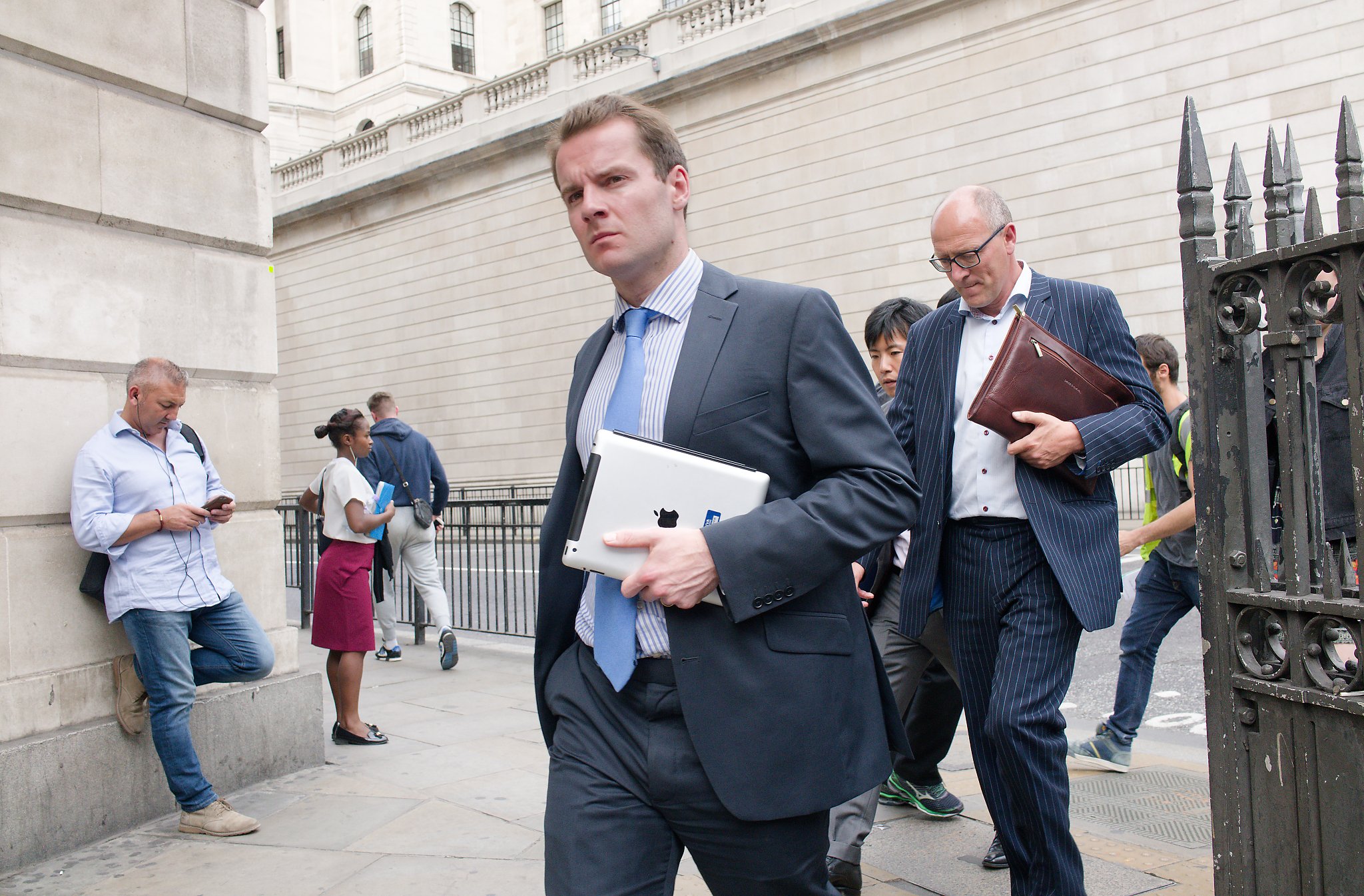
JLH: How do you know when an image belongs to a larger project rather than simply being an interesting photograph on its own?
MWP: This is tricky, because as photographers we quickly develop favourite images within a set. However, those images do not always fit into the narrative you are trying to construct around a subject. When that happens, they need to be removed, as they can complicate the work and become unnecessary diversions.
Learning to do that is difficult, and it took me a long time to become comfortable with it. There is a certain attachment to images that you like, and letting them go requires a bit of discipline.
Now I use a simple approach. I edit the work to the point where I feel it is complete, and then I force myself to remove one final image, no matter what. More often than not, it is the one I like the most. The reason it stands out is because it does not flow within the narrative.
Once it is removed, the flow returns, and the work begins to make sense again.
© Michael Wayne Plant
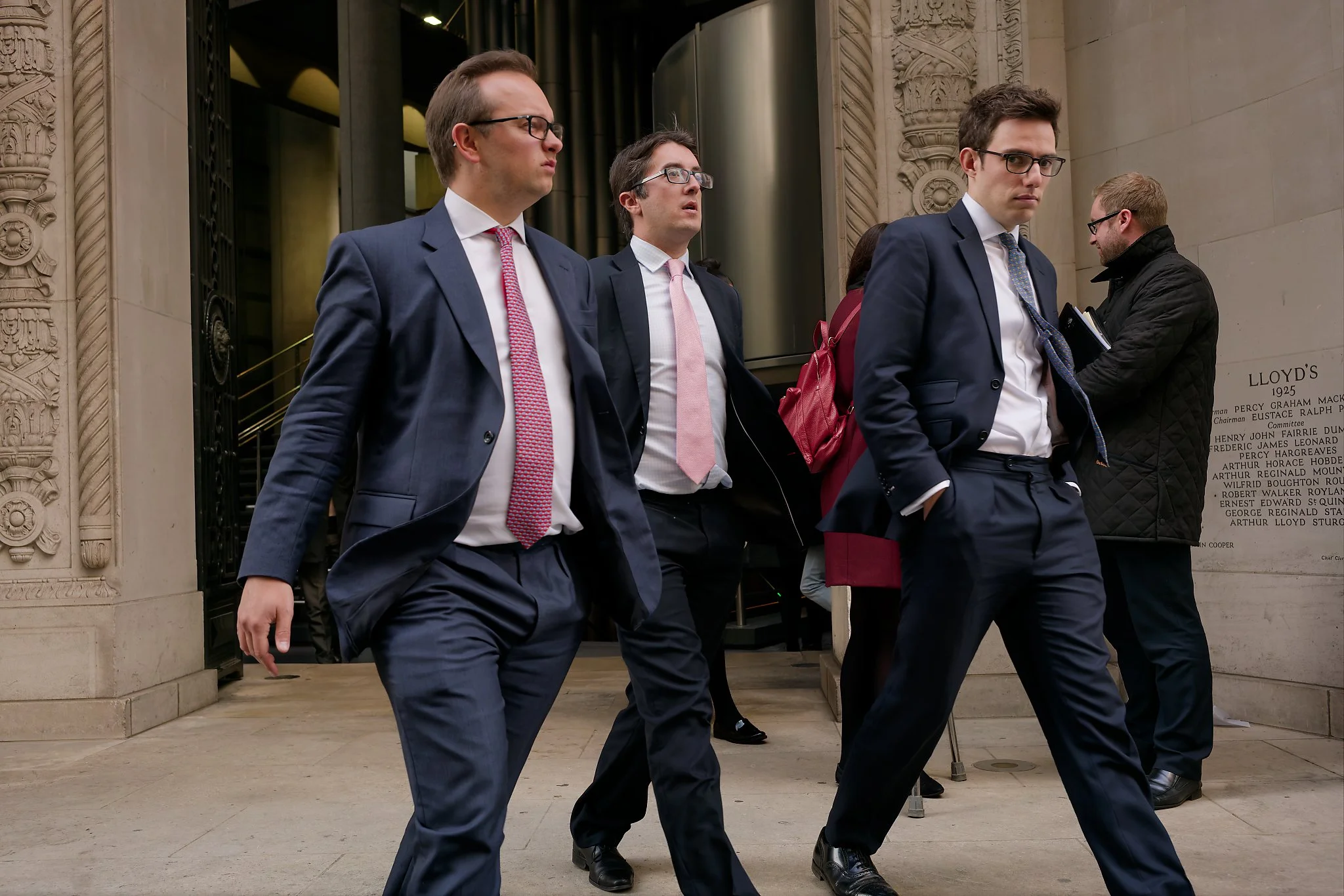
JLH: Documentary photography historically positioned itself as a tool for social change. Do you believe photography still has that power today?
MWP: Many documentary photographers are drawn to this area because they are socially aware and want to engage with the world around them. Part of that is a desire to make issues visible so that people can respond to them, and in some cases to support a wider sense of social justice.
Photography still has the potential to contribute to change, but not in a direct or immediate way. What it can do is raise awareness and shape how people see and understand a situation.
That is important, because people cannot respond to what they cannot see. Documentary work can make certain aspects of the world visible, and that visibility can support those who are trying to challenge or change those conditions.
Whether that leads to change depends on how the work is received and what happens beyond the photograph.
© Michael Wayne Plant
JLH: Do you believe photographers have a responsibility to interpret the world, or simply to show it?
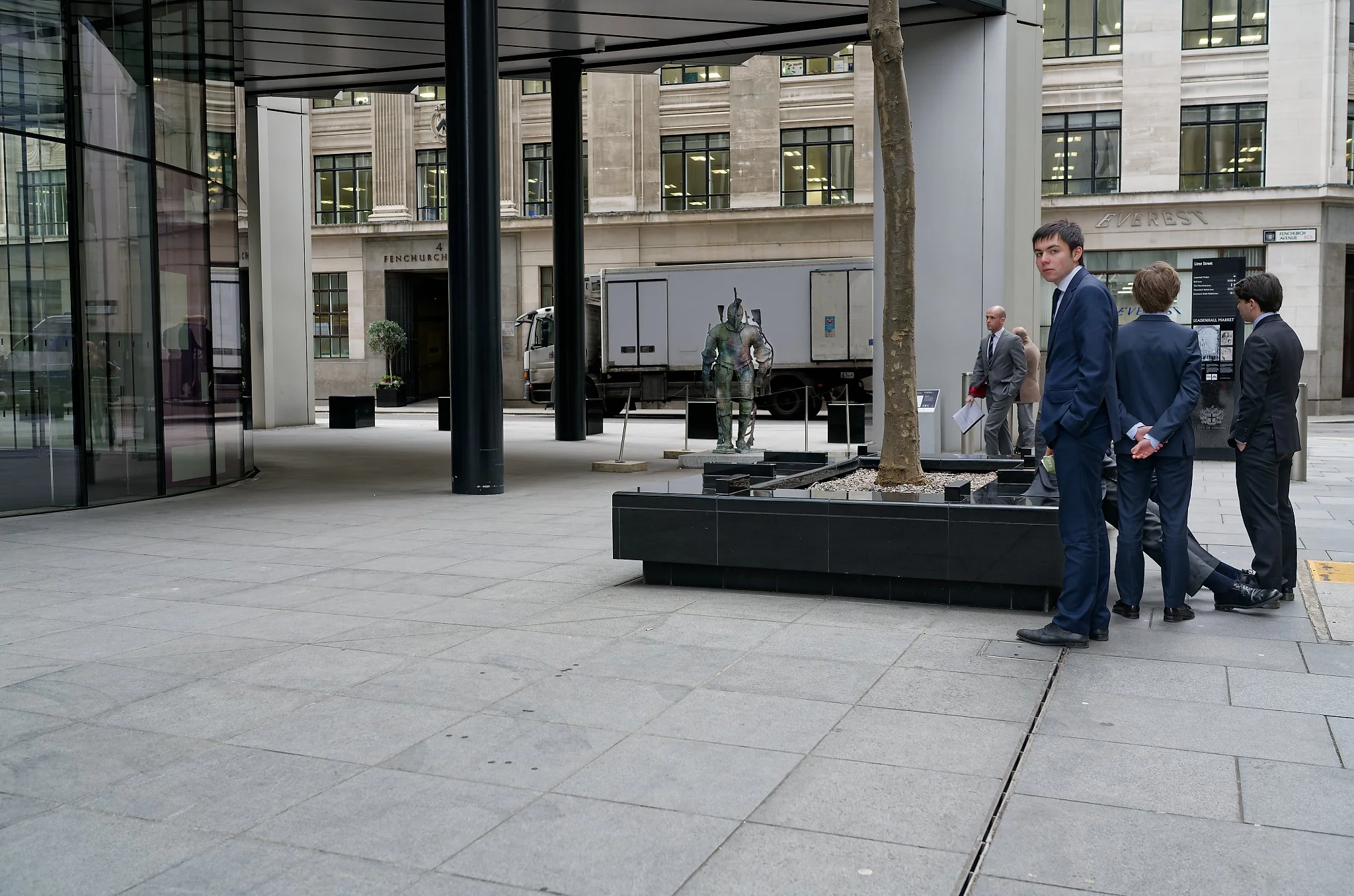
MWP: A photograph does not fully interpret the world, it shows a fragment of it. It cannot tell you what happened before or after that moment, only what was in front of the camera at a particular point in time.
Because of that, any single image is limited. It exists out of context, and can only ever offer a partial view.
At the same time, the photographer is always making decisions. Where you stand, what you include in the frame, and when you choose to release the shutter all shape what the image becomes.
Interpretation then develops further through the sequencing of images. When photographs are brought together, they begin to form relationships and a narrative that extends beyond what any single image can do on its own.
© Michael Wayne Plant
JLH: Your career moved from fashion and commercial photography to social documentary. Was that shift primarily artistic, intellectual, or ethical?
MWP: I reached a point where I began to question what I was doing. I started working in fashion photography when I was around 27, after arriving in London in the early 1990s, and I was fortunate to work for some good magazines, although not quite at the level I had originally hoped for.
I was influenced by photographers such as Peter Lindbergh, Steven Meisel and Patrick Demarchelier, whose work I admired, particularly the work being made in the 1980s. By the time I arrived in London, photographers like Juergen Teller were beginning to change the visual language of fashion photography.
Over time, my thinking began to shift. I became increasingly uncomfortable with the way fashion photography presents young women, and with my own role within that. That shift was happening before conversations like Me Too, but looking back, it was part of a broader change in how I understood the role of photography.
At the same time, I became more interested in how the world functions beyond image-making. That led me to study for an MA in Photography and Urban Cultures at Goldsmiths, where I began to think more seriously about how neoliberal capitalism shapes our lives and how those forces often remain invisible.
That combination of ethical concern, intellectual curiosity and a desire to engage more directly with the world is what led me towards social documentary photography.
JLH: In an age where billions of photographs are uploaded daily, what gives a documentary image lasting value?
MWP: A single image on its own does not necessarily have lasting value. Its significance often depends on how it is seen, where it is shown, and how it exists within a wider body of work.
In the current environment, where images are produced and shared in very large numbers, individual photographs can disappear quickly. This is particularly true on social media, where images are often seen in isolation, removed from the context that gives them meaning.
What gives an image weight is context, whether that is through a sustained project presented as a book, an exhibition, or an article, or even through a carefully constructed sequence online. These forms allow images to be seen together, where relationships between them can develop and a narrative can begin to emerge.
A good documentary photographer understands this and finds ways to bring the work into the world so that it can be seen in these forms. The value of the image is not only in its making, but in how it is presented and shared.
A documentary image gains value when it becomes part of something larger, where it contributes to a broader understanding rather than existing on its own.
JLH: How did studying photography within a sociology department influence the way you see images differently from photographers trained purely in art schools?
MWP: Most definitely, Goldsmiths did not show us how to make an image, I ended up being the technical adviser
to a lot of my fellow students as I already had 15 years of professional photography experience when I started my MA. The MA gave me a framework around which to construct my thinking on how the world functions, enabling me to question the processes that we do not see. This has helped be develop my photography processes that engage with the world and seek to show what is there.
Studying at Goldsmiths within a sociology department changed how I think about photography quite significantly. The course was not really about how to make images, it was more about how to understand the world those images sit within.
By that point I already had a strong technical background, so I often found myself helping other students with that side of things. What I gained from the MA was something different. It gave me a way of thinking about how social, economic and political structures shape everyday life, often in ways that are not immediately visible.
That is something that has stayed with me. It has helped me develop a way of working that engages more directly with the world, and to build photographic processes that seek to show what is there, rather than impose something onto it.
I no longer see photographs as isolated images, but as part of a wider set of relationships, connected to the conditions in which they are made and how they are seen. That way of thinking underpins how I now approach my work.
© Michael Wayne Plant
© Michael Wayne Plant
JLH: You currently do some work for DxO Labs. Can you tell us about the role, how did that opportunity come about, and how does working closely with imaging technology influence the way you think about photography?
MWP: For the first time in my life I saw a job listing on LinkedIn and I went that is my job, I just knew it when I saw it. I was at the time in a position where I was not getting to make much work as it was post covid and I was (I still am) caring for my in-laws with my wife. Because of this my work as a photographer has taken a back seat for the past 7 years. Seeing a job that I could do two days a week working from home with the occasional trip to the office was a great opportunity. Especially as the office is in Paris, who is not going to want a job like that. I get to speak with photographers and help them with online presence, discuss their social media and help them integrate DxO software into there workflows and help them with training and support. I have found that photographers appreciate my help as I have a unique set of skills developed over a lifetime of photography. I can help the with technical aspects of photography, marketing, training and theoretical concepts of where they are as photographers. It is a great privilege to be able to do this for a company like DxO as they are not a huge company and they make great photography software. PhotoLab is in my opinion the most flexible raw convertor software on the market. I started using it personally about 4 years before I joined DxO. The Nik collection I used to teach my students how to use it in photoshop classes when I was lead photography lecturer at an inner London college.
For the first time in my life I saw a job listing on LinkedIn and immediately thought, that is my job. I just knew it when I saw it.
At the time, I was not making much of my own work. It was the period after Covid, and I have been caring for my in-laws with my wife for several years, which meant my photography had taken more of a back seat. The role offered something that fit around that, working part-time from home with occasional trips to the office in Paris. I lived there for four years, so it is a place I have a strong connection to and it always feels special to return. For many people it is a dream to visit, and I have been fortunate enough to have lived there, so being able to go back through work, is something I appreciate.
The work itself involves speaking with photographers, helping them develop their online presence, and supporting them in integrating DxO software into their workflow. It also includes training and ongoing support. Over time I have realised that what I bring is a combination of experience built up over many years. I can help photographers not just with the technical side, but also with how they position themselves, how they think about their work, and where they are in their development.
It is a privilege to do that within a company like DxO. They are not a large company, but they make very strong tools for photographers. I had been using PhotoLab myself for several years before joining, and in my view it is one of the most flexible RAW processing tools available. I had also been using the Nik Collection for many years, including teaching it to my students when I was working as a photography lecturer in London.
JLH: Given your work with photographic software and image processing, how do you think new technologies like AI are changing the relationship between the photographer, the image, and the idea of authorship?
MWP: This is a tricky area to navigate as a photographer. Ai in photography is okay, it is also going to change the industry and it is going to change how we see photographs. Images have always been able to lie. People are now only waking up to this fact. All images are a construct, we make them by choosing where to stand, when to press the shutter, what lens we use, on top of that we process images to reflect our tastes of what an image should looked like. Digital imaging has unmoored the image from the thing that was photographed as the image can be manipulated at the pixel level. However the image still has a connection with what was in front of the camera. Ai image generators have not connection to the thing that was in front of a camera because they are not made with a camera. They are made with ideas formed into words, this actually makes them closer to painting as both painting and ai generated images start with a blank page/canvas. People who look at these images can be fooled into thinking they are real, when they are constructed images. The challenge for photographers is similar to that of writers in that a writer can use word to create a story or those same words to write a shopping list. The journalist in writing a newspaper article uses words to create a report of the situation and we learn to trust these journalist to be truthful and the reputation of the journalist becomes important in whether we trust the content of the article to be accurate. Photographers now have to think similarly if they destroy how we think about there work then we no longer trust any of there work. For me Steve McCurry used to be a great photographer until I found out that he was retouching his documentary image to remove elements from the frame. This small fact changes how I now see all his work as I no longer trust it to be documentary photography , however it is still good photo illustration.
Images have never been neutral. They are always constructed through decisions about where to stand, when to take the picture, and how it is processed afterwards. What has changed is that digital tools, and now AI, make that construction more visible and more flexible.
There is still a difference between a photograph and an AI-generated image. A photograph maintains a connection to something that was in front of the camera, even if it is interpreted or processed. AI-generated images do not have that connection. They are built from language and data, which makes them closer to illustration and painting than photography.
This places more responsibility on the photographer. In the same way that we learn to trust certain writers or journalists, the credibility of the photographer becomes important. If that trust is broken, it changes how the work is understood.
For example: when I discovered that Steve McCurry had been removing elements from his documentary images, it changed how I saw his work. For me it makes the images less visually compelling as I know they have been altered and it shifts them away from pure documentary and towards photo illustration.
JLH: After spending so many years observing the social landscape with a camera, what do you feel photography has ultimately taught you about people and society?
MWP: In the library at Goldsmiths I discovered the book Contemporary Photographers: Towards a Social Landscape, published alongside an exhibition in the United States featuring Bruce Davidson, Lee Friedlander, Garry Winogrand, Danny Lyon and Duane Michals. In the introduction, Nathan Lyons outlines the idea of a social landscape, which immediately resonated with me.
Reading that text clarified something I had already been moving towards. It helped me understand that this was the kind of work I wanted to make as I moved on from my earlier fashion photography. At the same time, I was becoming more aware of how the social order shaped by capitalism makes parts of everyday life difficult to see or fully understand.
Part of that, I think, is that we often lack both the time and the tools to recognise the forces shaping our lives. Photography has given me a way to slow down, to look more carefully, and to visualise aspects of that social landscape as something lived within our everyday experience, something that ultimately affects all of us.
That is what has stayed with me, and continues to shape the work I am making.
I just want to say thank you, to Jovis and the Urban Photographers Club, for taking the time to interview me.